 EN

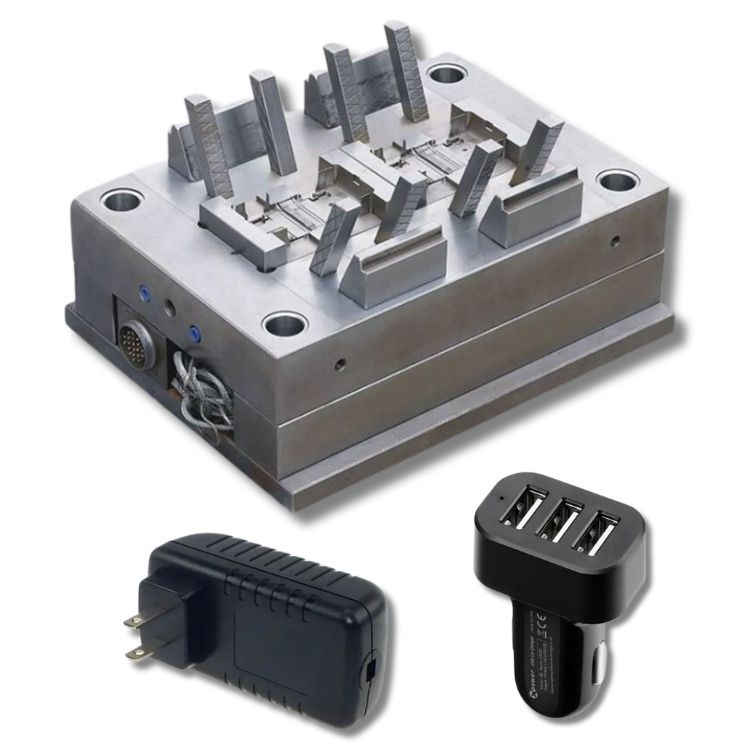
Material and Geometry Versatility of Injection Molding
Compatibility with 25,000+ Thermoplastic, Elastomeric, and Engineering Resins
Injection molding’s foundational versatility stems from its compatibility with over 25,000 thermoplastic, elastomeric, and engineering resin grades—enabling precise alignment between material properties and functional requirements. Whether a part demands the flexibility of TPEs for soft-touch grips or the rigidity and thermal stability of glass-filled PEEK, engineers can select a compound that balances mechanical strength, chemical resistance, dimensional stability, and cost. Critical processing parameters—including melt flow rate, viscosity, and thermal conductivity—directly influence mold fill behavior, cycle time, and surface fidelity. To mitigate inherent challenges like warping, shrinkage, or thermal degradation, manufacturers routinely incorporate stabilizers, reinforcements, or conductive fillers—enhancing performance without sacrificing processability. This breadth of material choice makes injection molding the definitive method for transforming raw polymer pellets into high-integrity, application-optimized components across aerospace, medical, automotive, and consumer electronics.
Precision Micro-Features, Thin Walls, and Multi-Cavity Complexity in One Cycle
Injection molding uniquely combines micron-level precision with macro-scale geometric complexity—all within a single, fully automated cycle. It reliably produces features as fine as 0.1 mm, thin walls down to 0.5 mm, living hinges, molded-in threads, snap-fits, and intricate undercuts—eliminating secondary operations and assembly steps. Multi-cavity molds further amplify this capability by producing identical or functionally distinct parts simultaneously, enabling throughput gains of 4×, 8×, or more per cycle without compromising repeatability. Advanced mold design and simulation ensure consistent melt flow—even with multi-material or variable-thickness geometries—delivering part-to-part consistency across millions of cycles. This fusion of micro-accuracy, structural integration, and high-speed scalability is unmatched by machining, thermoforming, or additive manufacturing—making injection molding indispensable for miniaturized medical devices, microelectronics housings, and high-reliability consumer hardware.
Real-World Validation: Hinge Brackets via Two-Shot Injection Molding
A leading global technology manufacturer leverages two-shot (overmolding) injection molding to produce hinge brackets for premium laptops—demonstrating the process’s highest tier of material and functional integration. In one uninterrupted cycle, the mold first forms a rigid, dimensionally stable core from glass-fiber-reinforced polyamide. The mold then rotates, and a second shot of impact-modified thermoplastic elastomer (TPE) is injected to create an integrated soft-touch bumper and strain-relief zone. This co-molded structure eliminates adhesives, fasteners, and manual assembly—while delivering a molecular-level bond stronger than mechanical joining. The resulting hinge withstands over 30,000 open-close cycles with silent, smooth operation and zero fatigue-induced failure—validating injection molding’s singular capacity to solve demanding, multi-material, high-cycle-life design challenges.
Scalability Without Design Compromise in Injection Molding
Seamless Transition from Prototyping (100 parts) to Mass Production (1M+ parts/year)
Injection molding enables a seamless, low-risk scale-up—from initial validation runs of 100 prototype parts to annual production volumes exceeding 1 million—without redesigning the part or requalifying materials. Aluminum or soft-steel prototype molds replicate the exact cavity geometry, gate location, venting, and cooling logic used in final production tooling. As demand grows, engineers scale output by increasing cavity count (e.g., from 1 to 8 or 16 cavities) rather than altering part topology or tolerances. Because process windows—including melt temperature, injection speed, and packing pressure—are established during prototyping, cycle times remain stable across volume tiers. This continuity avoids costly retooling, revalidation, and supply chain disruption—making injection molding uniquely suited for products that evolve from niche launch to mainstream adoption.
Modular Mold Design and Conformal Cooling for Consistent Part Fidelity
Maintaining part fidelity at scale hinges on thermal control—and modern injection molding tooling delivers it through modular mold architecture and conformal cooling. Modular bases allow rapid swap-out of cavity inserts or entire mold plates, so scaling from low- to high-volume production requires only targeted upgrades—not full mold replacement. Conformal cooling channels—fabricated via metal 3D printing—trace the part’s contours precisely, eliminating hot spots and reducing average cycle times by up to 30% compared to conventional straight-drilled cooling (Industry Benchmark Report, 2023). This uniform heat extraction minimizes residual stress and warpage, holding critical dimensions within ±0.05 mm across the entire production lifespan. Together, these innovations ensure that the first part off the line matches the millionth in geometry, surface finish, and mechanical performance—proving that scalability need not compromise quality.
Cost-Per-Part Leadership for Mid-to-High Volume Injection Molding
Injection molding achieves its strongest economic advantage at mid-to-high volumes—typically starting around 5,000 units—where high upfront tooling costs are amortized across large production runs. Automation, minimal labor per part, and near-zero material waste converge to drive dramatic per-unit savings as volume increases. Industry benchmarks illustrate this effect clearly:
| Production Volume | Mold (USD) | Material/Piece | Labor/Piece | Total Cost | Cost per Part |
|---|---|---|---|---|---|
| 5,000 units | $2,500 | $0.50 | $2.00 | $15,000 | $3.00 |
| 100,000 units | $25,000 | $0.50 | $1.00 | $175,000 | $1.75 |
At million-part volumes, unit costs routinely fall between $0.05 and $0.50—driven by long-life hardened-steel molds, lights-out automation, and optimized cycle efficiency. Crucially, this cost leadership does not require simplifying part geometry or limiting material options. Businesses retain full access to the process’s design freedom and material library while achieving predictable, scalable unit economics—making injection molding the most financially resilient path from concept to mass-market deployment.
FAQs
What materials can be used in injection molding?
Injection molding is compatible with over 25,000 thermoplastic, elastomeric, and engineering resin grades, offering extensive material versatility.
What are the geometric capabilities of injection molding?
Injection molding can create features as fine as 0.1 mm, walls as thin as 0.5 mm, and complex geometries like snap-fits and molded-in threads within a single cycle.
How scalable is the injection molding process?
Injection molding supports seamless scalability from prototype runs (100 parts) to mass production (1M+ parts per year) without significant redesign.
What are the cost advantages of injection molding?
The process achieves strong cost-per-part leadership at mid-to-high volumes, with per-unit costs decreasing dramatically as production scale increases.