 EN

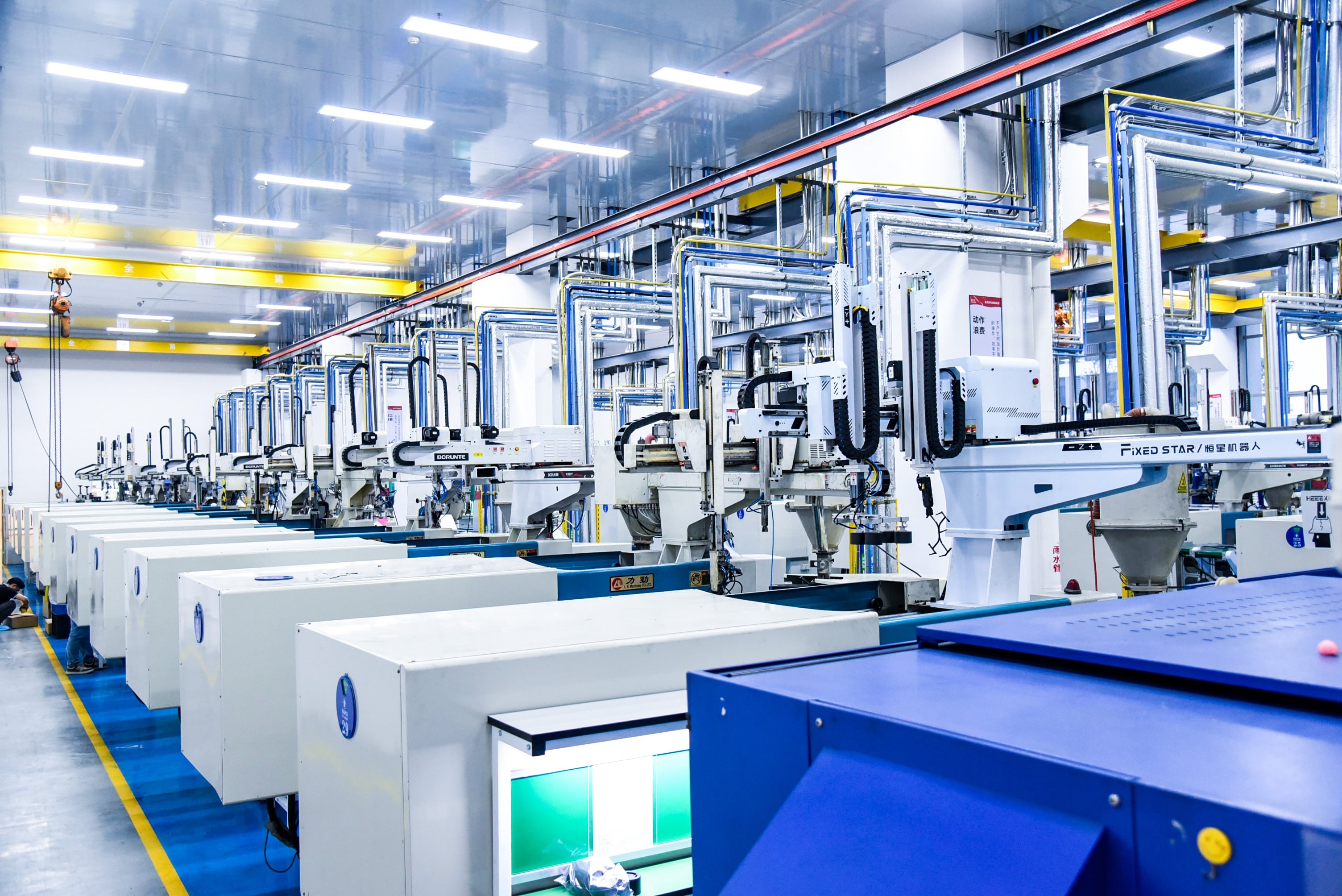
Lightweight Structural Integration: Battery Enclosures and Module Housings via Automotive Injection Molding
Automotive injection molding transforms large-format battery enclosures and module housings into integrated, load-bearing structures—replacing multi-piece metal assemblies with fewer, consolidated parts. These molded components feature built-in sealing grooves, mounting brackets, and precise dimensional control, significantly improving assembly efficiency and structural consistency.
Design Advantages: Uniform wall thickness, draft optimization, and shrinkage control for dimensional stability
Uniform wall thickness—often as thin as 1.2 mm—minimizes sink marks, internal stress, and warpage. Draft angles of 1° to 3° on deep ribs and bosses ensure clean ejection without compromising critical sealing surfaces. Shrinkage is managed through material-specific compensation and conformal cooling, enabling tight tolerances across mating faces, busbar channels, and module retention points. These design principles are foundational for dimensional stability in large enclosures.
Lightweighting delivers measurable range gains: every 10 kg removed from an EV improves driving range by 5–8% (2024 industry data). Glass-filled polypropylene (GF-PP) and PC/ABS grades provide stiffness, chemical resistance, and flame-retardant options while supporting uniform wall sections. Molded-in mounting features and snap-fit interfaces reduce assembly time and eliminate secondary operations. Crucially, consistent wall geometry prevents differential shrinkage at thick-to-thin transitions—a leading cause of leakage in coolant channels and seal grooves. The result is a dimensionally stable enclosure that fits battery modules precisely, without post-mold machining.
Real-World Impact: Long-Glass-Fiber Polypropylene Modular Enclosures Achieving 23% Weight Reduction vs. Aluminum Without Compromising Crash Integrity
A leading battery manufacturer has deployed long-glass-fiber polypropylene (LGF-PP) in modular enclosures via automotive injection molding, achieving a 23% weight reduction versus aluminum while maintaining full crash integrity per ISO 12405 and UN ECE R100 requirements. LGF-PP’s enhanced impact strength and energy absorption—combined with strategically molded ribs—redirect crash loads away from sensitive cell modules. Because the process consolidates brackets, bosses, and sealing channels into single parts, assembly steps decrease and dimensional variation remains tightly controlled.
This one-piece LGF-PP design reduces component count from dozens of stamped and welded aluminum parts to just a few molded modules—boosting production consistency and cutting lifecycle manufacturing energy. It demonstrates that polymer-intensive enclosures can meet side-pole and underbody impact standards without metal’s mass penalty, establishing a scalable path for next-generation modular battery systems.
Precision Thermal Management: Coolant Manifolds and Pump Housings Through Automotive Injection Molding
Multi-material integration: Overmolded seals, embedded channels, and fiber-reinforced flow paths for 800V battery systems
Automotive injection molding enables coolant manifolds and pump housings to integrate rigid thermoplastic bodies with elastomeric overmolded seals in a single cycle. Embedded channel geometries route glycol-based coolant precisely across cell stacks, power electronics, and charging modules. For 800V battery systems, leak-tightness is non-negotiable: coolant contact with live busbars risks short circuits or thermal runaway.
Fiber-reinforced flow paths—using polyphenylene sulfide (PPS) or polyamide 66 (PA66)—retain dimensional stability under continuous exposure above 120°C. Overmolding eliminates post-mold assembly of O-rings and gaskets, reducing part count by 30–40% in leading battery-pack designs. Integrated internal ribs further enhance burst strength and minimize pressure drop, enabling more compact, high-efficiency coolant routing—critical for high-energy-density packs.
Process-critical considerations: Warpage mitigation, flow uniformity, and fiber orientation effects on thermal conductivity
Warpage in long-glass-fiber reinforced manifolds often arises from anisotropic shrinkage between flow and cross-flow directions. Mold designers mitigate this using conformal cooling channels placed 5–8 mm from the cavity surface—balancing heat removal and reducing cycle time by 15–25%. Flow uniformity is equally vital: resin velocity gradients cause inconsistent fiber alignment, which directly impacts thermal performance. Aligned fibers can increase in-plane thermal conductivity up to threefold versus random orientation—enhancing heat dissipation near seal interfaces and critical junctions.
Simulation tools predict fiber orientation tensors and warpage before tooling is cut, preventing costly weld-line displacement and ensuring flatness ≤0.2 mm on sealing faces for reliable O-ring compression. Tight process control also minimizes internal voids—preserving pressure retention in high-voltage coolant loops where even micro-leakage poses safety risks.
High-Voltage Interconnect Reliability: Insert Molding of Busbar Carriers and Connectors
In new energy vehicle battery systems, automotive injection molding produces insert-molded busbar carriers and high-voltage connectors that embed copper conductors within protective polymer encapsulation. This single-step process eliminates secondary assembly and significantly improves resistance to vibration, moisture ingress, and thermal cycling. Components are typically molded from high-dielectric-strength, tracking-resistant resins—such as reinforced polyamide or PBT—engineered to maintain insulation integrity under sustained 800V-class operation. Because connector mating faces must sustain consistent contact pressure and sealing geometry across harsh under-hood conditions, insert placement accuracy and material compatibility are reliability-critical.
Tight-tolerance requirements: <±0.05 mm insert placement accuracy and thermal expansion compensation strategies
Insert molding for EV busbar carriers demands sub-50-µm placement accuracy (<±0.05 mm), as minor deviations compromise contact alignment, sealing geometry, and creepage distances. Achieving this requires precision mold tooling with secure insert-loading mechanisms and zero-deflection support during injection. Gate location, fill speed, and pressure are carefully tuned to avoid deflecting thin copper or aluminum busbars—particularly vulnerable in long, slender configurations.
Differential thermal expansion remains the dominant long-term risk: metals and polymers expand at different rates during temperature cycling—from cold-soak (-40°C) to fast-charge peaks (>85°C). To mitigate interfacial stress, designers select resins and conductor materials with closely matched coefficients of thermal expansion (CTE), incorporate strain-relief geometries, and use flexible sealing interfaces. These strategies preserve stable electrical contact, insulation resistance, and mechanical integrity over the battery pack’s full service life.
Material Compliance and Safety Assurance in Automotive Injection Molding for EV Batteries
UL94 V-0 and UL 2596 compliance: Balancing flame retardancy (halogen-free PC/ABS, GF-PP), mechanical robustness, and recyclability
Material compliance for EV battery enclosures hinges on aligning flame-retardant performance with mechanical durability and end-of-life considerations. UL 94 V-0 validates self-extinguishing behavior under standardized flame exposure; UL 2596 evaluates system-level resistance to thermal runaway propagation and mechanical abuse—including nail penetration, crush, and fire exposure tests.
Halogen-free PC/ABS blends deliver high impact strength, dimensional stability, and reliable V-0 performance without corrosive off-gassing. Glass-fiber-reinforced polypropylene (GF-PP) offers weight and cost advantages but often requires intumescent or phosphorus-nitrogen flame-retardant systems to achieve V-0 without degrading recyclability. In contrast, conventional brominated additives impair recycling streams and generate hazardous decomposition products.
Because flame-retardant packages are sensitive to processing, melt temperature, shear rate, and mold cooling must be tightly controlled to prevent degradation that compromises both UL 94 V-0 ratings and UL 2596 thermal runaway containment. Therefore, material qualification should integrate UL test data with mechanical validation—including tensile, impact, and creep testing—and recycled-content trials conducted under production-representative conditions. This holistic approach ensures regulatory compliance while supporting circular economy goals and future battery reuse or recycling pathways.
FAQ
What is automotive injection molding?
Automotive injection molding is a manufacturing process that creates integrated and load-bearing structures for components such as battery enclosures, pump housings, and connectors. It involves injecting molten material into molds to form precise, durable, and functional parts.
What materials are commonly used in injection molding for EV batteries?
Common materials include glass-filled polypropylene (GF-PP), polycarbonate/ABS (PC/ABS) blends, polyamide 66 (PA66), polyphenylene sulfide (PPS), and reinforced polyamide or PBT. These materials offer properties like high stiffness, flame retardancy, and dimensional stability.
How does lightweighting improve EV performance?
Reducing weight by replacing metal components with molded polymers can improve electric vehicle driving range by 5–8% for every 10 kg removed, enhance crash safety, and increase manufacturing efficiency.
What are the key considerations in precision thermal management for EVs?
Key considerations include warpage mitigation, flow uniformity, and managing fiber orientation to improve thermal conductivity in coolant manifolds and pump housings used in high-voltage battery systems.
How does injection molding ensure high-voltage interconnect reliability?
Injection molding integrates copper conductors in protective polymer encapsulations, ensuring tolerance requirements, vibration resistance, and thermal expansion compensation to maintain long-term reliability and insulation integrity.
Table of Contents
- Lightweight Structural Integration: Battery Enclosures and Module Housings via Automotive Injection Molding
- Precision Thermal Management: Coolant Manifolds and Pump Housings Through Automotive Injection Molding
- High-Voltage Interconnect Reliability: Insert Molding of Busbar Carriers and Connectors
- Material Compliance and Safety Assurance in Automotive Injection Molding for EV Batteries
- FAQ